
Every Senior’s Name, 300 Drones: Inside San Marcos High’s Sky Show |
Creative Skies explains the flight plans and safety checks behind the October 23 Senior Night display. |
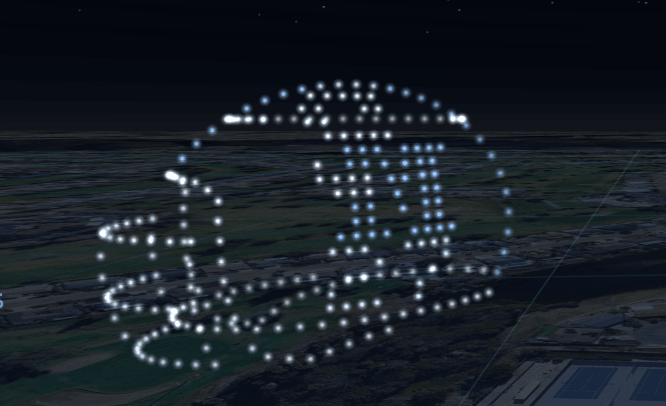
For approximately 15 minutes on October 23, the sky above San Marcos High School became something you don't see at an ordinary Friday night football game. Three hundred illuminated drones formed moving images above the stadium, celebrating the Knights and their graduating seniors.
And this wasn't just another football animation. Creative Skies spelled out every senior football player's name in the sky. That's a pretty memorable way to recognize a graduating class.
The company behind it, Creative Skies Drone Light Shows, has an office right here in Vista. In an original interview conducted for North Valley Flare, CEO Rodrigo Serzedello took us behind the scenes to explain the technology, planning, and people responsible for sending 300 drones into the night sky without crashing into one another.
So how do 300 drones pull that off without crashing?
Three Hundred Drones. Three Hundred Individual Flight Plans.
Imagine a giant animated movie where every pixel is a flying robot. That's how Serzedello describes the basic concept behind a drone light show.
Each drone represents a single point of light. But unlike pixels on a screen, these points have to physically move through three-dimensional space.
Before a performance, specialized software calculates where every drone needs to be, how fast it should travel, how high it should fly, and precisely when it should arrive at each position.
And here's the surprising part: the drones aren't talking to one another.
According to Serzedello, the drones used in these performances don't rely on onboard collision-avoidance sensors or communicate directly with neighboring drones to coordinate their movements. Instead, each aircraft follows its own individually programmed flight path.
“Our software analyzes the movements to ensure that flight paths maintain safe separation and that drones don’t cross into each other’s space,” Serzedello explained.
Highly accurate GPS positioning, enhanced by technology called RTK, helps the drones maintain their intended positions. Under favorable conditions, Serzedello says the system can achieve accuracy within a few centimeters.
That's 300 separate aircraft following their own instructions, yet forming one picture in the night sky.
It's rather like choreographing an entire dance company where none of the dancers can see what the others are doing. |
San Marcos High Senior Night drone show. Video courtesy of Creative Skies Drone Light Shows, used with permission. |
The Show Begins Long Before Takeoff
“Everything starts with a story,” Serzedello said.
Creative Skies begins by understanding what the client wants the audience to experience. Designers develop visual concepts and storyboards, then transform those ideas into three-dimensional animations.
Those animations become hundreds of individual flight paths. Every transition must account for speed, acceleration, positioning, and safe separation between aircraft.
The entire performance is simulated before a single drone leaves the ground.
And then comes the physical preparation.
For a 300-drone show, the crew arranges hundreds of aircraft into a precisely measured launch grid. Each drone must be positioned, powered, inspected, and connected to the ground-control system.
Batteries are charged individually in advance. Communication equipment, positioning systems, antennas, and computers must be installed and tested.
Serzedello says a typical operation involves approximately five to ten people, depending on the show's size and complexity.
There's also an easily overlooked detail that can become an expensive mistake: measuring the height of nearby buildings and trees. As Serzedello explained, miscalculating the show's lowest altitude could result in thousands of dollars in losses within seconds.
The audience sees a few minutes of magic. The crew sees days of preparation.
A Small Aviation Control Center Behind the Scenes
Once the show begins, nobody is standing on the ground manually steering 300 individual drones. The choreography is largely automated.
But the human operators are far from spectators themselves.
The flight crew monitors aircraft positions, battery levels, communication links, weather conditions, and other critical information through a ground-control system. Additional personnel observe the airspace and maintain the safety perimeter. |
Behind the scenes of the San Marcos High drone show. Video courtesy of Creative Skies Drone Light Shows, used with permission. |
“So while the audience sees a beautiful animation in the sky, behind the scenes we’re essentially operating a small aviation control center,” Serzedello said.
And because these are actual aircraft, not animated lights on a computer screen, safety is a central consideration.
Before each performance, Creative Skies establishes procedures for unexpected wind, communication interruptions, positioning problems, and equipment malfunctions.
If a drone encounters trouble, the crew can respond according to established procedures, potentially initiating a controlled landing or stopping the performance.
Creative Skies says it operates under FAA authorizations for coordinated drone flights.
A successful show, Serzedello explained, isn't simply about creating impressive images. It's also about knowing when conditions are safe enough to proceed.
When the Sky Becomes Personal
At San Marcos High, the technology had a very specific job: celebrate the seniors.
Creative Skies didn't simply send 300 drones into the air to display generic football imagery. The company personalized the choreography around the school, its traditions, and its senior players.
Writing individual names across the sky transformed the performance into a celebration of the students themselves. And that's what made this particular show memorable to the people who created it. |
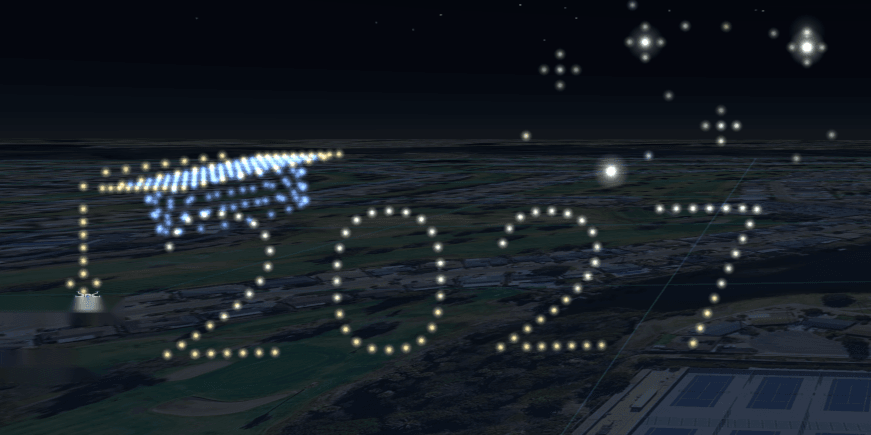 The Class of 2027 graduation-cap formation depicted in Creative Skies’ 3D reconstruction of the San Marcos High Senior Night show. Courtesy of Creative Skies Drone Light Shows. Used with permission. |
“For us, the most rewarding part was seeing the students, families, and community looking up and realizing that the entire sky had become a celebration of their achievements,” Serzedello shared.
For the graduating seniors, it was a moment unlike the usual stadium announcement or recognition ceremony. For everyone else watching, it raised a pretty reasonable question: how much work does it take to put names in the sky?
The Next Generation of Drone Shows
Creative Skies is already exploring ways to make drone performances more interactive. One of its technologies, SkyRender Sync, allows spectators to synchronize music and sound effects with a performance through their smartphones. A QR code displayed in the sky can direct viewers to the experience.
The company is also developing AI-assisted creative tools and experimenting with more dynamic changes to drone colors and formations. Serzedello even imagines a future where audiences could experience something resembling a giant game of Tetris played across the night sky.
And after all the engineering, programming, and meticulous preparation, the goal remains remarkably simple. “We’re always interested in finding entirely new ways to make people look up and say, ‘Wow,’” Serzedello said.
Questions You May Have About Drone Light Shows
Do the drones communicate with one another to avoid collisions? According to Creative Skies, the drones follow individually programmed flight paths. Software calculates those paths in advance to maintain safe separation.
How accurately can the drones position themselves? The company uses GPS enhanced by RTK positioning technology, which Serzedello says can achieve accuracy within a few centimeters under favorable conditions.
How many people does it take to operate a drone show? Creative Skies says a typical production involves approximately five to ten people, depending on the size and complexity of the performance.
What happens if the weather changes or a drone malfunctions? The crew monitors conditions and aircraft systems throughout the show. Depending on the situation, operators can initiate safety procedures, land an affected drone, or stop the performance.
|
© 2026 North Valley Flare. For reprint or syndication inquiries, contact our editorial team at hello@flarepublications.com. Images and video require separate permission from their respective rights holders. |
❤️ Enjoyed this story? Don’t miss what’s happening around Vista and San Marcos! Get local news, community stories, events, and more delivered straight to your inbox. Good Vibes. Great Stories. Right in Your Inbox. Subscribe to North Valley Flare → Free to subscribe. Local stories worth sharing. |


2 Comments
Join the conversation
I had no idea the drones don't talk to each other. Kinda amazing they can fly that close just following their own plans!
WOW! Seeing every senior player's name in the sky must have been so special for those families. What a night for the Knights!